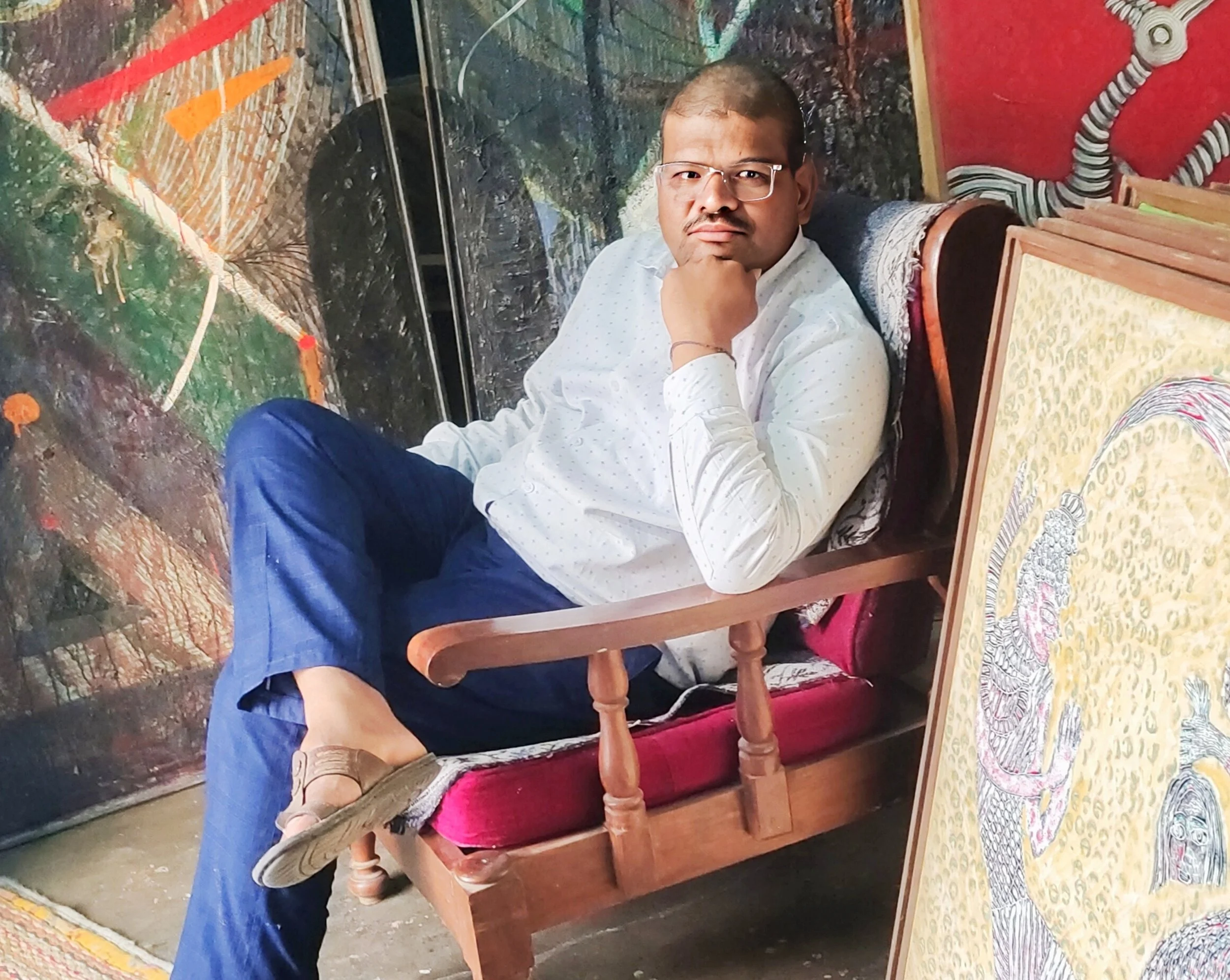
Rounak rai
I do not present sexuality as a subject for provocation. I use desire as a psychological and symbolic starting point. The work asks what happens when desire is unconscious, when it becomes obsession, and when it is consciously transformed through love, responsibility, surrender and awareness.
The project moves from the body toward consciousness without rejecting the body. It treats lived experience as raw material and painting as a method of transformation.
Lust seeks to possess. Love seeks to unite. Tantra seeks to transform. Devotion seeks to surrender. Wisdom seeks to detach. And consciousness seeks to transcend.
“My life, my art and my spiritual journey are not three different stories. They are one story.”
Artist Statement
I am an Indian contemporary artist, who, through my artistic journey was trying to understand a fundamental question:
Why can desire become love in one situation, but obsession, exploitation, violence or crime in another?
“Sex Tantra: Victory of Love on Lust” is a series of paintings deeply connected with my own life. I believe that an artist does not only paint what he sees. An artist often paints what he has lived, questioned, struggled with, and gradually understood. During my early professional artistic period, I explored the human body, sexuality, desire, violence, obsession and the darker psychological aspects of relationships. As my understanding of intimacy changed through marriage, emotional companionship and family life, that question gradually became more important to me than sexuality itself. This became an important turning point, and I began to experience the difference between physical desire and emotional connection. My relationship with desire evolved as something that does not necessarily have to be simply rejected or condemned. It can also become something that we observe, understand and transform.
As my artistic journey developed, I moved towards Indian mythology and spiritual traditions. I created works inspired by the Ramayana, Mahabharata, Krishna, Shiva, Devi and other Indian mythological narratives. I was not interested only in illustrating these stories, but rather in their symbolic and psychological dimensions. This brought me towards Tantra, including my study and exploration of traditions associated with Bhairavi Tantra and Kamakhya Tantra. For me, Tantra is not simply about sexual activity. It is a way of looking directly at human existence—including desire, fear, attachment, the body, energy, consciousness, love, death and transcendence—and asking whether these experiences can become pathways towards greater awareness. This became the conceptual foundation of my Sex Tantra series.
One of the central symbolic ideas in my paintings is Kundalini. In Tantric and Yogic traditions, Kundalini is represented as dormant Shakti associated with the base of the body. Its awakening is symbolically represented as an upward movement through the central channel, Sushumna, towards Sahasrara, where Shakti and Shiva are symbolically united. I do not present this as a biological process or claim that sexual activity automatically produces spiritual awakening. In my art, it is a symbolic journey of transformation. The same human energy that can remain trapped in unconscious desire can, through awareness, love, discipline, spiritual practice and inner transformation, become associated with higher states of consciousness.
Therefore, my central question is:
“What can human desire become when it is understood rather than blindly followed?”
This is the heart of “Sex Tantra: Victory of Love on Lust.”

Sex Tantra: Victory of Love on Lust, 2026
Acrylic on Canvas, 5’x8’
The title “Victory of Love on Lust” represents the central transformation within my work.
It does not mean that sexuality is evil or that love simply replaces the body.
It means moving from unconscious possession towards conscious connection.
Lust seeks to possess.
Love seeks to unite.
Tantra seeks to transform.
Devotion seeks to surrender.
Wisdom seeks to detach.
And consciousness seeks to transcend.
My work is ultimately an exploration of the space between body and spirit, desire and awareness, instinct and consciousness, personal experience and transcendence.
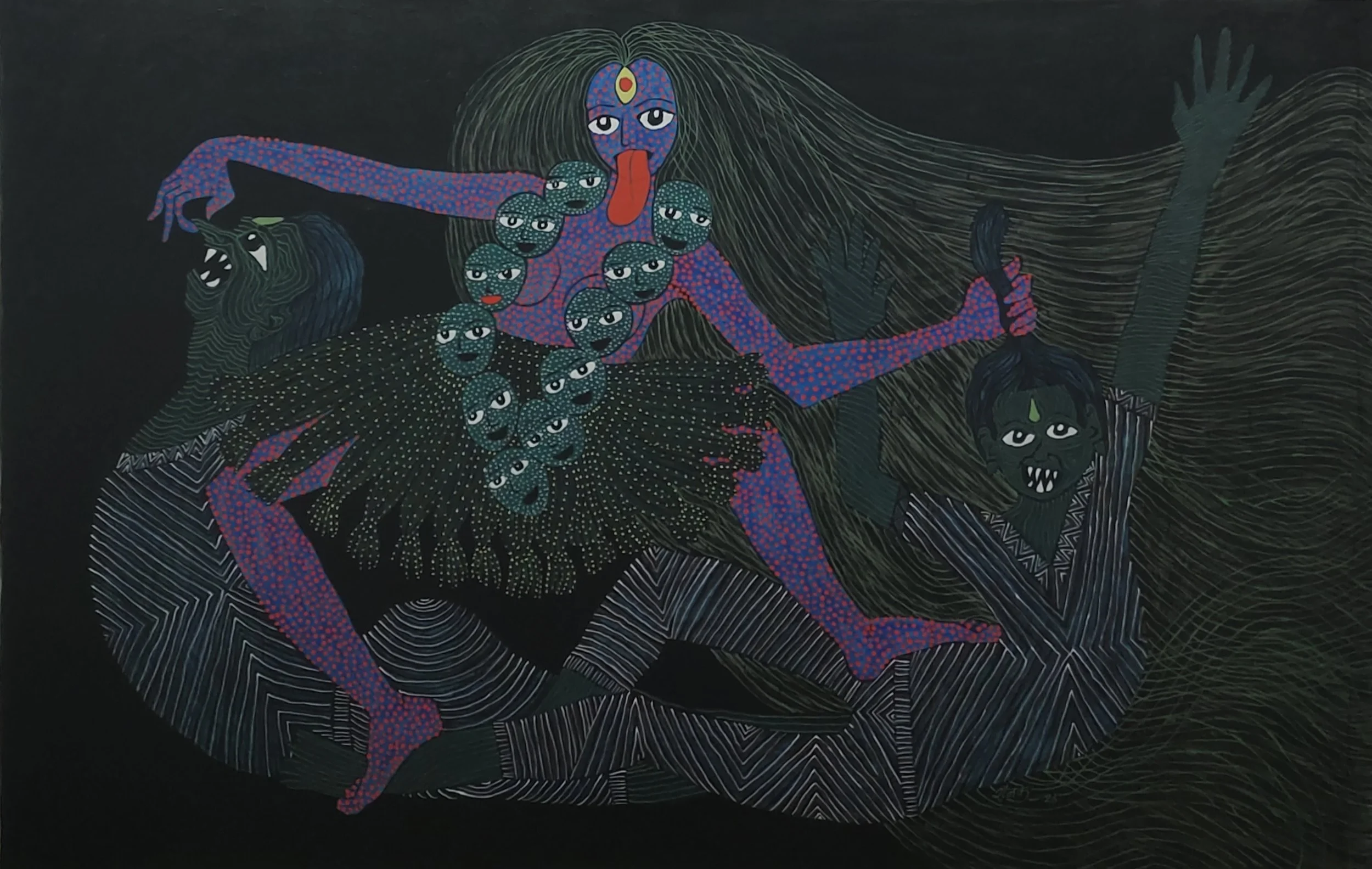
Kali Maternal Discipline, 2026
Acrylic on Canvas, 5’x8’
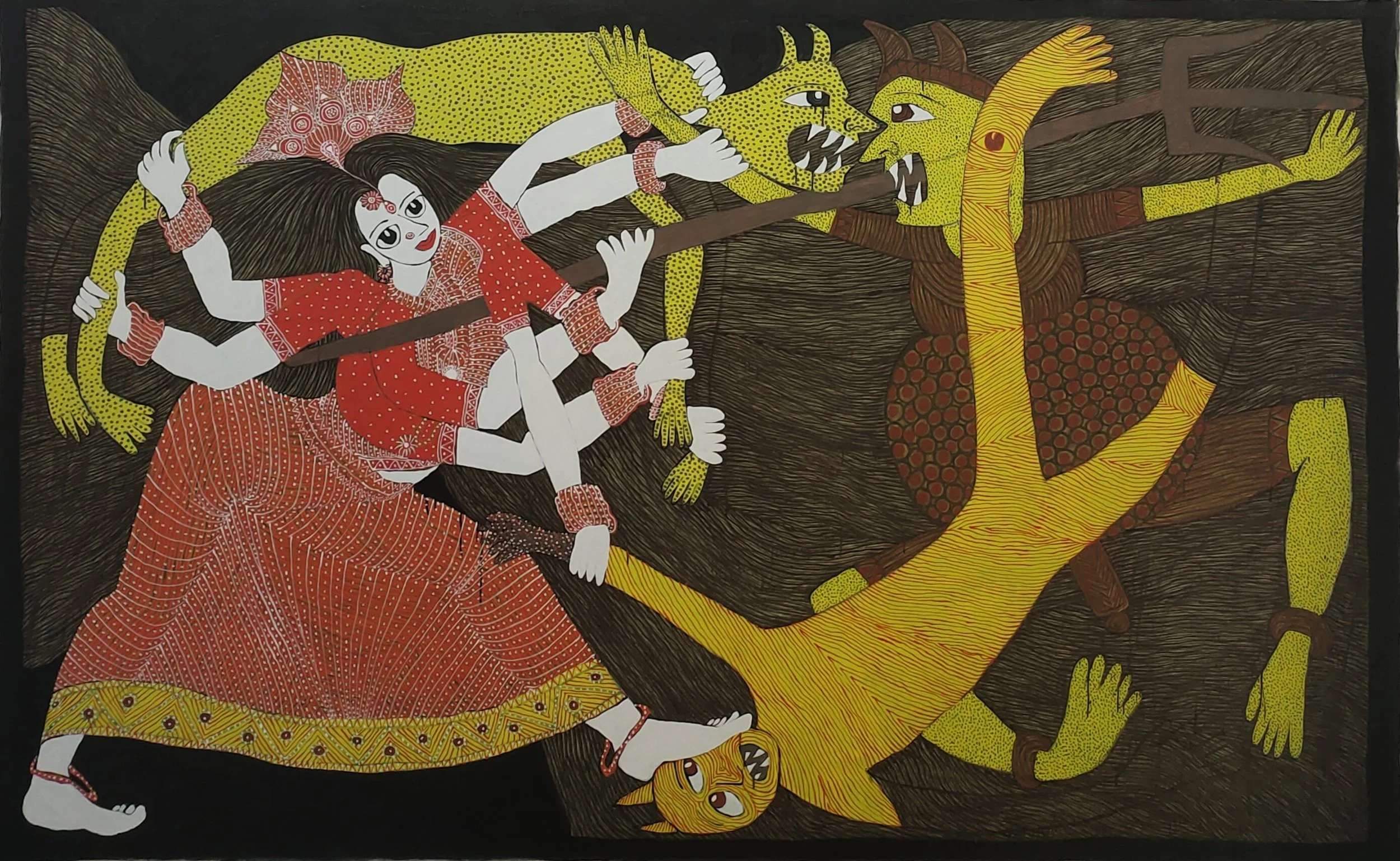
Durga the Ultimate Fighter, 2026
Acrylic on Canvas, 5’x8’
My Kali and Durga paintings are also connected to this same journey.
I began painting Kali and Durga as powerful forces confronting destruction. In my interpretation, mythological figures such as Mahishasura, Shumbha and Nishumbha can also function as metaphors for contemporary forms of domination, violence, exploitation and oppression. Durga represents resistance, protection and courage. Kali represents an uncompromising force that confronts and destroys destructive energies.
This connects my spiritual and mythological work with my concern for women's dignity, violence against women and the misuse of sexual power. Therefore, the transition from Sex & Crime to Kali and Durga is not a change of subject.
It is a continuation of the same artistic question. Earlier, I was examining the darkness. Later, I began searching for the force capable of confronting that darkness. I do not believe that spirituality requires us to pretend that human desire does not exist. The deeper question is whether we can understand desire deeply enough that it no longer controls our consciousness.